Dialing the Quantum-Classical Border
4/4/2026
The Copenhagen interpretation taught generations of physicists that measurement is binary: you either observe a quantum system or you don’t. A real experiment says otherwise. By smoothly tuning how much information a detector collects, physicists can watch interference patterns fade gradually from quantum to classical. The transition isn’t a switch. It’s a spectrum, and the math behind it is surprisingly simple.
The Switch That Isn’t a Switch
Here is the story of quantum measurement as most people learn it. You send electrons through two slits, one at a time. Each electron lands as a single dot on a screen. But after thousands of electrons, the dots form an interference pattern: alternating bright and dark bands, as if each electron somehow passed through both slits at once and interfered with itself.
Now put a detector at one of the slits to see which way the electron goes. The interference pattern vanishes. The electrons land in two simple clumps, like tiny bullets. Observe the particle and you “collapse the wave function.” Don’t observe it and the wave function evolves undisturbed.
On or off. Watched or unwatched. Quantum or classical.
This framing, inherited from the Copenhagen interpretation of quantum mechanics, makes measurement sound like a light switch. But what if it’s actually a dimmer?
When Two Quantum Systems Meet
To understand why, we need to look at what happens when a quantum particle interacts with another system. An electron travels from point A to point B along two possible paths. At point B, the contributions from both paths combine. If the peaks of one path line up with the peaks of the other, they reinforce: bright fringe. If a peak meets a trough, they cancel: dark fringe. This is interference, and it’s the signature of quantum behavior.
Now imagine a second system sitting near the paths. It could be anything: a molecule of air, a grain of dust, a strip of metal. As the electron passes, it nudges the second system slightly. If the nudge is exactly the same regardless of which path the electron takes, nothing changes. The two paths still combine the same way. Interference survives.
But if the second system responds differently depending on which path the electron takes, something new happens. The electron’s two paths are no longer identical journeys that end at the same destination. Each path now comes packaged with a different state of the second system. Path 1 leaves the environment in state A. Path 2 leaves it in state B.
Here is the critical point. To produce interference, you need to combine the contributions from both paths. But the contributions are now attached to different environmental states. The combination only works to the extent that those environmental states overlap. If states A and B are identical, the environment carries no record of which path was taken, and interference is perfect. If A and B are completely different, the environment has effectively recorded which way the electron went, and interference is destroyed. The two paths have been “tagged.”
The amount of overlap between those environmental states controls everything. Physicists call that overlap . When , the environmental states are identical: full interference. When , the environmental states are perfectly distinguishable: no interference. And can take every value in between. The quantum-to-classical transition isn’t a switch. It’s a dial, and the position of the dial is set by how much the environment has learned about the particle’s path.
A Metal Plate as an Observer
In 2007, Sonnentag and Hasselbach at the University of Tübingen built a device that lets you turn this dial by hand.
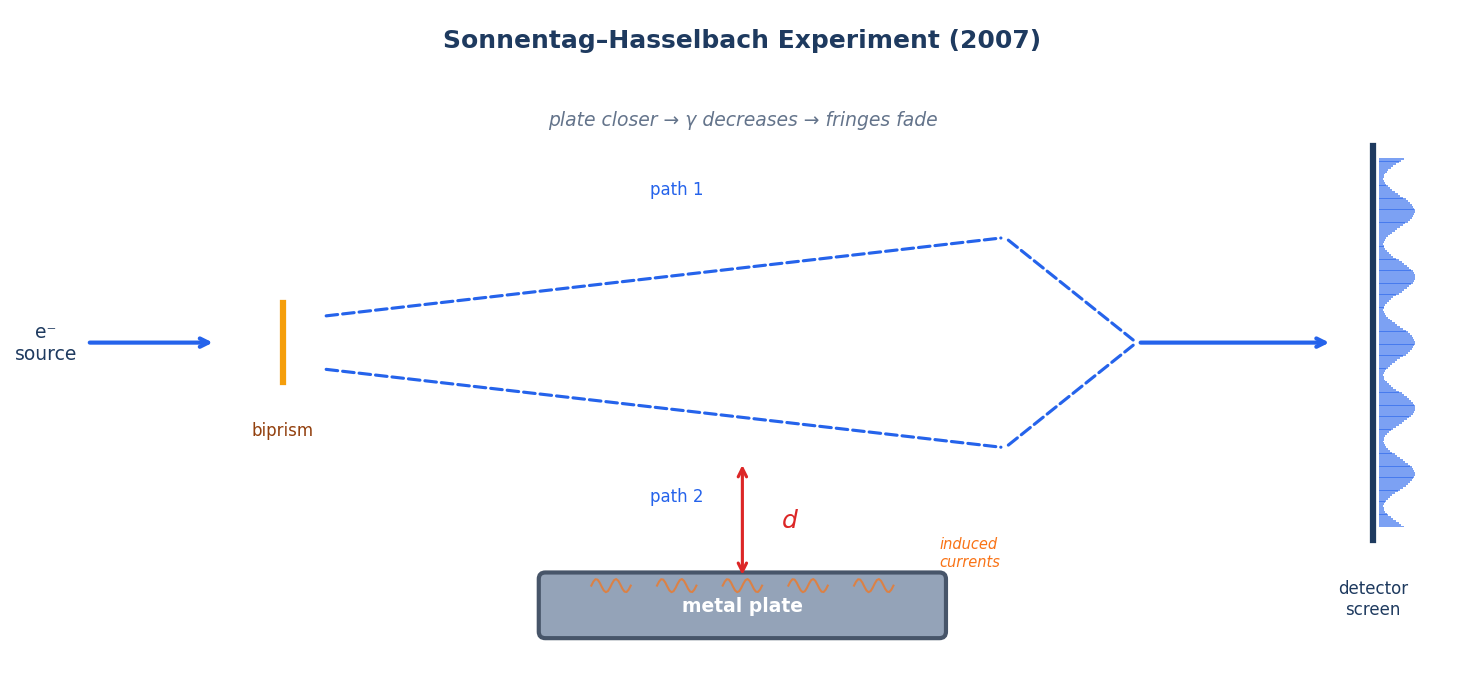
Their setup works like this. An electron beam is split into two parallel paths using an electrostatic biprism, a thin charged wire that deflects electrons to either side, like a prism splitting light. The two paths travel side by side for a short distance and then recombine onto a detector screen. When nothing disturbs the paths, the electrons produce clear interference fringes: the telltale bright and dark bands of quantum behavior.
Then the experimenters introduced a small metal plate near the two paths.
As an electron passes near the plate, its electric field pushes charges around inside the metal, inducing tiny currents. If the electron is on path 1, the currents have one pattern. If it’s on path 2, the pattern is slightly different. The plate’s internal state has become correlated with the electron’s path. The induced currents are the environmental states A and B. The plate is the observer.
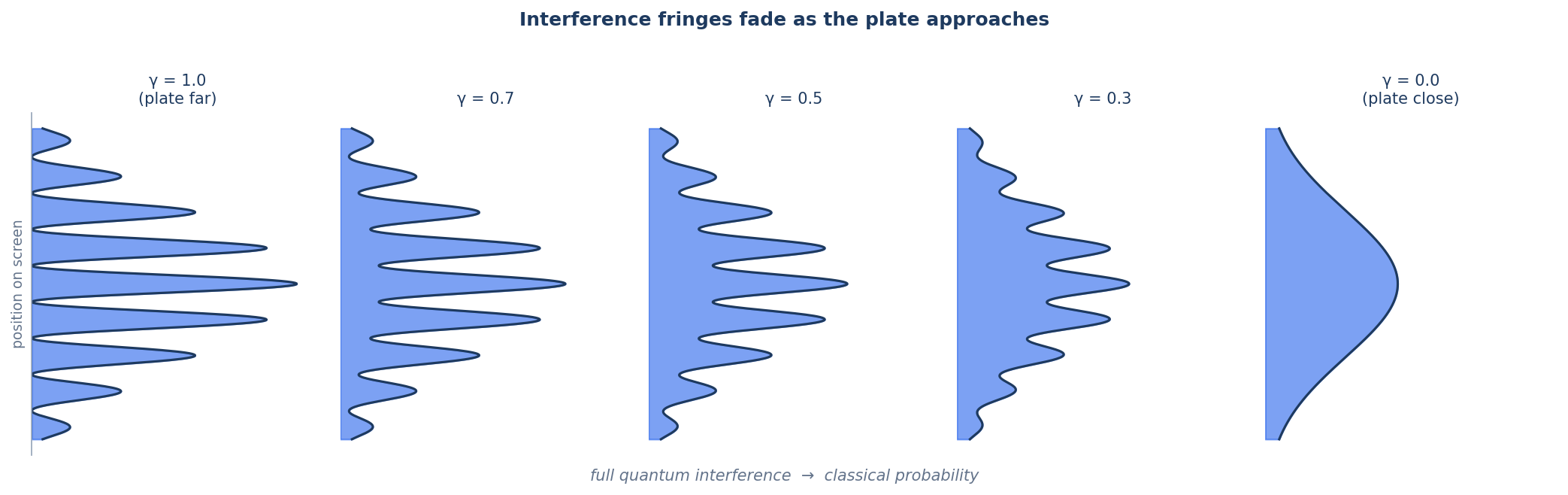
The dial is the distance. When the plate is far away, the induced currents are so faint that the two patterns are virtually identical. The plate learns nothing about which path the electron took. is close to 1, and interference is strong. As the plate moves closer, the currents grow stronger and more distinct. The plate starts carrying real which-path information. drops, and the fringes fade. Move the plate closer still, and the fringes disappear entirely. All that remains is the smooth classical pattern of two overlapping beams.
Pull the plate back, and the fringes return.
No detector clicked. No conscious observer watched. A piece of metal got closer to an electron beam, and quantum interference smoothly dissolved into classical probability. The experimenters had built a physical knob for the quantum-classical border.
The Equation Behind the Fringes
The detected intensity at each point is the sum of two terms: the classical contribution (what you’d see if the two beams had no quantum relationship at all) plus an interference term whose amplitude is controlled by :
The first two terms are the classical sum of both beams. The cosine term is the interference, and controls its strength.
When , the interference term is at full strength. You see prominent bright and dark fringes. When , the interference term vanishes. You see only the flat classical pattern. For any value of in between, the fringes are present but dimmer, like turning down the contrast on a photograph.
There is a quantitative constraint that makes the trade-off exact. Define as the visibility of the fringes (how prominent the stripes are, from 0 to 1) and as the distinguishability of the two paths (how well the environment can determine which way the particle went, also from 0 to 1). Quantum mechanics requires:
Plot on one axis and on the other, and the constraint traces out a quarter-circle. You can be anywhere on or inside the arc, but never outside it. Perfect fringes and perfect which-path knowledge cannot coexist.
In the Sonnentag-Hasselbach experiment, moving the plate closer increases and decreases , and the data points walk along that arc. You can literally watch the trade-off between wave behavior and particle behavior play out, point by point, as a function of plate distance. The complementarity principle, usually presented as an abstract philosophical statement about the nature of quantum reality, becomes a curve you can fit to data.
What Copenhagen Missed
Bohr and Heisenberg built quantum mechanics in the 1920s, but they left a hole in the middle of it. Before measurement, the system evolves smoothly according to the Schrödinger equation. At the moment of measurement, the wave function “collapses” to a definite outcome: sudden, probabilistic, irreversible. Their framework, the Copenhagen interpretation, never explains the collapse. It simply asserts that measuring devices are classical objects that live outside the quantum formalism, and that when a quantum system meets one, the rules change.
This made measurement seem like a gap in the physics. If the measuring device is made of atoms, and atoms are quantum mechanical, where does “quantum” stop and “classical” start? Copenhagen drew a line but had no principled way to say where it should go. The question of what counts as an “observer” drifted into philosophy, consciousness, and decades of popular writing that treated the question as more mysterious than it needed to be.
The standard undergraduate curriculum reinforces the blind spot. Griffiths’ Introduction to Quantum Mechanics, the canonical textbook for a generation of physics students, goes out of its way to note that the “pesky i’s” (the complex phases that make quantum mechanics quantum) drop out of the time-independent Schrödinger equation. Most of the course is spent solving for energy levels and bound states, problems where the complex phases cancel and the math is effectively real. Interference, the phenomenon that makes quantum mechanics fundamentally different from classical physics, barely appears until the final chapters and receives little sustained discussion. Decoherence, the process that connects quantum behavior back to the classical world we experience, is absent entirely. Students can complete a full year of undergraduate quantum mechanics and emerge without a clear understanding of the most important quantum mechanical phenomenon: how complex amplitudes combine to produce interference, and how the loss of that interference through environmental entanglement is what makes the world look classical.
Decoherence cuts through most of this confusion. When a quantum system becomes entangled with its environment, interference between the system’s different states is suppressed, and the system begins to look classical. The critical insight is that the Schrödinger equation, applied to the system and its environment together, produces this result automatically. No special collapse postulate is needed. No line between quantum and classical must be drawn by hand.
A caveat is important here. Decoherence explains why interference vanishes and why macroscopic objects look classical. It does not explain why any particular measurement yields the specific outcome you observe rather than another one. That question, sometimes called the “problem of outcomes,” remains genuinely open. But for the vast majority of laboratory situations, decoherence accounts for everything we see. Interference fades because information leaks into the environment, not because an observer collapses anything.
The Sonnentag-Hasselbach experiment makes this tangible. The “collapse” is entanglement with a metal plate. The “observer” is induced currents in a resistor. The “measurement” happens gradually, controlled by a distance knob. Nothing in the experiment requires a conscious observer or a classical measuring device invoked from outside the theory. The quantum formalism, applied honestly to the electron and the plate together, predicts exactly the smooth transition from interference to no interference that appears on the screen.
The Universe Observes Itself
“Measurement” is just information leaking from a system into degrees of freedom nobody tracks. The metal plate doesn’t “look” at the electron. It simply responds electromagnetically to whatever passes nearby. In doing so, it carries away partial which-path information in the form of induced currents, dissipated heat, and displaced charges. Those internal degrees of freedom are practically impossible to reverse, so the entanglement becomes permanent for all practical purposes.
This process is everywhere, all the time. Air molecules bouncing off an object carry away information about its position. Photons scattering off a surface carry away information about its shape. A metal plate near an electron beam carries away information about the electron’s path. In each case, entanglement spreads, interference is suppressed, and the world looks a little more classical.
Copenhagen made it sound like the universe needs someone watching to decide what’s real. Decoherence reveals something simpler and stranger: the universe is watching itself, constantly, through every interaction between every system and its surroundings. The quantum-to-classical transition happens everywhere, at every scale, in every moment. The Sonnentag-Hasselbach experiment is special only because it lets you slow the process down enough to see it happen, one turn of the dial at a time.
References
- P. Sonnentag and F. Hasselbach, “Measurement of Decoherence of Electron Waves and Visualization of the Quantum-Classical Transition,” Physical Review Letters 98, 200402 (2007). DOI
- P. Sonnentag and F. Hasselbach, “Decoherence of Electron Waves Due to Induced Charges Moving Through a Nearby Resistive Material,” Brazilian Journal of Physics 35(2B), 385–390 (2005). DOI
- J. R. Anglin, J. P. Paz, and W. H. Zurek, “Deconstructing Decoherence,” Physical Review A 55, 4041 (1997). DOI
- W. H. Zurek, “Decoherence, einselection, and the quantum origins of the classical,” Reviews of Modern Physics 75, 715 (2003). DOI
- B.-G. Englert, “Fringe Visibility and Which-Way Information: An Inequality,” Physical Review Letters 77, 2154 (1996). DOI — derives the complementarity relation.
- P. Kazemi et al., “Quantum carpets: a tool to observe decoherence,” New Journal of Physics 15, 013052 (2013). DOI — proposes using spatiotemporal interference patterns to visualize decoherence in real time, including electrons near metal surfaces.
- D. J. Griffiths, Introduction to Quantum Mechanics, 3rd ed. (Cambridge University Press, 2018) — the standard undergraduate text discussed in this article.
Further Reading
- Quantum decoherence — overview of the decoherence program and its implications for the measurement problem.
- Double-slit experiment — the foundational interference experiment discussed in the opening.
- Copenhagen interpretation — the standard interpretation of quantum mechanics and its treatment of measurement.
- Wave-particle duality — the complementarity between wave and particle behavior, quantified by the relation.
- Measurement problem — the open question that decoherence partially but not fully resolves.
- Electron diffraction — the broader experimental context for electron interference and biprism interferometry.
- Wojciech Zurek — pioneer of the decoherence and einselection framework.
Popular Science Coverage
- Quantum Darwinism, an Idea to Explain Objective Reality, Passes First Tests — Philip Ball, Quanta Magazine (2019). How Zurek’s framework for the emergence of classical reality passed its first experimental tests.
- Real-Life Schrödinger’s Cats Probe the Boundary of the Quantum World — Philip Ball, Quanta Magazine (2018). Experiments pushing quantum behavior to larger and larger scales, exploring where decoherence takes over.
- W. H. Zurek, “Decoherence and the Transition from Quantum to Classical — Revisited,” Physics Today 44(10), 36–44 (1991; updated 2003). DOI — Zurek’s own accessible introduction to decoherence, written for a broad physics audience.
- Philip Ball, Beyond Weird: Why Everything You Thought You Knew about Quantum Physics Is Different (University of Chicago Press, 2018) — a book-length treatment of decoherence, measurement, and why the popular understanding of quantum mechanics is mostly wrong.